Memory & Runtime Basics
Memory and runtime basics explain object lifetime, garbage collection, leaks and allocation-related performance problems in Android apps.
Managed memory on Android
ART manages Java and Kotlin objects in a per-process heap. An app also uses memory outside that heap, including thread stacks, native allocations, code, graphics buffers and memory-mapped files. Garbage collection reclaims managed objects; it does not release every kind of resource or native allocation.
Stack and heap
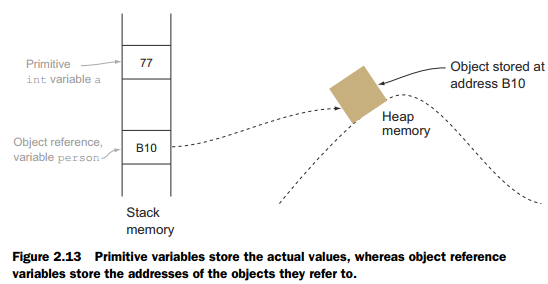
Each thread has a call stack containing frames for active calls, including bookkeeping and some local values. Frames are removed when calls return. Deep or infinite recursion can exhaust the stack and cause StackOverflowError.
Objects are normally allocated in the managed heap, while a local variable may hold a reference to an object. The stack-versus-heap model is useful, but exact placement is a runtime implementation detail: ART may optimize allocations. If the process cannot satisfy an allocation, it can fail with OutOfMemoryError even when some unreachable objects have not yet been reclaimed.
Reachability and garbage collection
The collector starts from GC roots, such as active threads, static fields and JNI references, and follows reference chains. A managed object becomes eligible for collection when it is no longer reachable, not merely when the application has finished using it. Cycles can be collected if no path from a root reaches them.
A memory leak is therefore usually a lifetime bug: an object is still reachable but no longer useful. Common Android examples include a singleton retaining an Activity, a listener that was not removed, or work whose callback outlives its screen. GC timing is not deterministic, and resource cleanup should use lifecycle APIs or Closeable, not finalization.
Strong, soft, weak and phantom references
- A strong reference is an ordinary reference and keeps its target reachable.
- A weak reference does not keep its target alive. It can help with auxiliary mappings, but it is not a substitute for explicit listener removal or lifecycle ownership.
- A soft reference may survive until memory pressure increases. Its clearing policy is not predictable, so Android caches should normally use explicit size limits, such as
LruCache. - A phantom reference is used with
ReferenceQueuefor low-level post-mortem processing. Application code rarely needs it;Cleaneror explicit resource ownership is usually clearer.
Frequent temporary allocations can trigger more GC work and contribute to jank. Measure with Android Studio or Perfetto before optimizing, and inspect retained-reference paths when diagnosing a leak.