Algorithms & Complexity
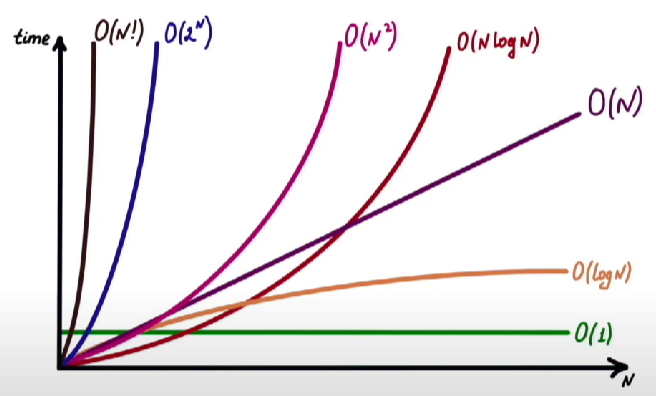
Algorithmic complexity estimates how resource usage grows with input size. It matters in interviews and in application code that searches, sorts, groups or renders growing collections.
Big O
Big O describes an asymptotic upper bound for time or space growth. It does not predict milliseconds. Constants and lower-order terms are omitted, so O(2n + 10) becomes O(n).
Always state what n represents and which case is being discussed:
- Worst case gives a limit for any valid input of size
n. - Average case depends on assumptions about input distribution.
- Amortized cost spreads occasional expensive operations across a sequence, such as resizing an
ArrayList.
Time and auxiliary-space complexity are separate. An algorithm may reduce time by building an additional set or map.
Common growth rates
O(1): constant work, such as array access by index.O(log n): the remaining problem shrinks by a constant factor, as in binary search.O(n): one full pass overnelements.O(n log n): common for efficient comparison sorting.O(n²): work over many pairs, such as a simple double comparison loop.O(2ⁿ)orO(n!): exhaustive combinations or permutations; practical only for small inputs unless pruned.
Count total work rather than loop syntax. Two consecutive O(n) loops are O(n), not O(n²). Nested loops may be O(n²), O(n log n) or O(n × m) depending on their bounds. A loop that repeatedly halves its range is O(log n).
Search
Linear search over an unsorted list is O(n). Binary search is O(log n), but it requires data sorted with the same ordering used by the search.
Binary search is effective on arrays and random-access lists because reading the middle element is O(1). On a linked list, locating each middle position requires traversal, removing the practical advantage.
Sorting once costs about O(n log n). It may be worthwhile before many searches, but not necessarily before a single lookup. If frequent membership checks are the goal and ordering is unnecessary, building a HashSet in O(n) often gives expected O(1) lookups.
Sorting
| Algorithm | Best | Average | Worst | Auxiliary space | Practical note |
|---|---|---|---|---|---|
| Bubble sort | O(n) with early exit |
O(n²) |
O(n²) |
O(1) |
Educational; rarely appropriate in production. |
| Insertion sort | O(n) |
O(n²) |
O(n²) |
O(1) |
Useful inside hybrid sorts for small or nearly sorted ranges. |
| Merge sort | O(n log n) |
O(n log n) |
O(n log n) |
Usually O(n) |
Predictable and stable in common implementations. |
| Quicksort | O(n log n) |
O(n log n) |
O(n²) |
O(log n) average, O(n) worst stack |
Fast in-place partitioning; quality depends on pivot and implementation. |
Production sort functions are commonly optimized or hybrid implementations. Prefer the standard library unless the algorithm itself is the task. Check API guarantees when stability, memory or worst-case bounds matter.
Collection operation costs
The table describes common JVM implementations and typical costs, not every List or Map implementation.
| Structure | Read / lookup | Insert | Remove | Practical note |
|---|---|---|---|---|
ArrayList |
O(1) by index; O(n) by value |
Amortized O(1) at end; O(n) in middle |
O(n) in middle |
Strong default for sequential data and iteration. |
LinkedList |
O(n) by index or value |
O(1) at known node or end; otherwise O(n) to locate |
Same: locating often dominates | Nodes are not exposed by the Java API; poor locality often outweighs theoretical benefits. |
ArrayDeque |
O(1) at either end |
Amortized O(1) at either end |
O(1) at either end |
Prefer for stack or queue behavior. |
HashMap |
Expected O(1) by key |
Expected O(1) |
Expected O(1) |
Depends on hashing, equality, capacity and key distribution. |
HashSet |
Expected O(1) membership |
Expected O(1) |
Expected O(1) |
Useful for uniqueness and membership checks. |
ArrayList.add() is amortized O(1): most appends are constant-time, while occasional growth copies the backing array in O(n). A sequence of n appends still costs O(n) overall.
Hash collections rely on stable, consistent equals() and hashCode(). Mutating fields used by either function while an object is a key or set element can make it effectively unreachable. Poor distribution increases collisions and degrades performance.
HashMap is not thread-safe. Concurrent structural modification requires external synchronization or a concurrent collection; see ConcurrentHashMap.
Complexity in Android code
Big O predicts scaling, but two O(n) implementations can behave very differently because of allocations, cache locality, boxing, I/O or work performed on the main thread. A small input may not justify a more complex algorithm; a linear operation repeated for every frame may still cause jank.
First identify realistic input sizes and the user-visible bottleneck. Use profiling, Microbenchmark for isolated hot code, and Macrobenchmark for flows such as startup or scrolling. Optimize measured work while keeping correctness and readability.
Related topics: Collections, Java Core, Performance & Memory, and Java Concurrency.